Plant Visual Checklist: Common Clues, Lookalikes, and Next Steps
A practical checklist of plant visual clues, common lookalikes, and safe next steps to turn photos and observations into reliable identification leads.
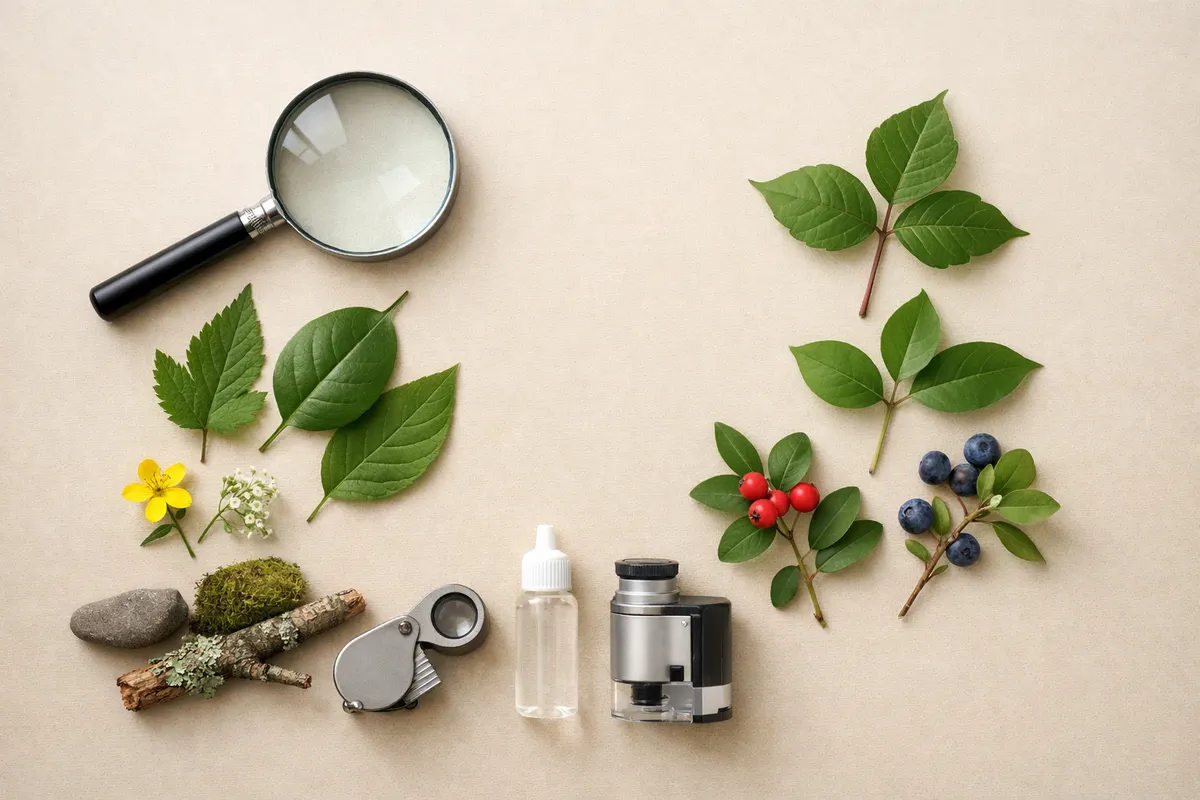
Quick answer for plant visual clues
Plant visual clues are the observable leaf, stem, flower, and context details you can check in a photo or in the field to narrow possible species. Focus first on a few reliable features—leaf shape, venation, arrangement, and any flowers or fruit—rather than trying to match the whole plant at once.
A single good photo plus habitat notes can point to likely matches, but it rarely proves a definitive identification. Treat visual clues as a way to build a short list and decide safe next steps: gather more photos, note season and location, compare lookalikes, or consult a specialist.
What it means
When people search for plant visual clues they want clear, repeatable signals that separate one species from another. That means preferring diagnostic features—traits that are consistent for a species and visible without specialized tools—over variable traits like color intensity or leaf damage. For example, leaf arrangement (opposite vs. alternate) and venation pattern are often more diagnostic than exact hue.
Visual clues combine two kinds of evidence: morphology (what the plant looks like) and context (where and when you saw it). Morphology includes leaf shape, margins, veins, stems, buds, flowers, and fruit. Context covers habitat (wetland, roadside, lawn), substrate (rocky, clay, sandy), elevation, and time of year. Both matter: the same leaf shape in a lawn and in a salt marsh usually points to different groups of plants.
In practical terms, treat visual clues like checklist items. Each checked clue increases your confidence and narrows the candidate list. Missed or ambiguous clues—blurred veins, hidden petioles, missing flowers—should lower your confidence and trigger follow-up actions rather than a final claim.
Key clues
Below are the strongest visual and contextual clues to check when you’re evaluating a plant photo. Start with the items that are easiest to confirm from an image, and only move to harder or invasive checks if you need higher confidence.
Arrange your notes from most diagnostic to least: leaves and flowers first, then stems and bark, then ecological context and scent (when available). Make a short checklist from these items for each plant you photograph so you can compare multiple candidates efficiently.
- Leaf shape: entire (oval), lobed (oak-like), needle, or compound (pinnate/ternate). A lobed leaf with deep sinuses points toward oaks, maples, or geranium-like species depending on the lobing pattern.
- Leaf margin: smooth, serrated, or crenate. Regular, fine serrations differ from coarse, irregular teeth and can separate birch-like species from many roses and nettles.
- Venation pattern: pinnate (one main midrib), palmate (several main veins from one point), parallel (grasses and lilies). Visible second- and third-order veins can be diagnostic for maples, hollies, and many shrubs.
- Leaf arrangement: alternate, opposite, or whorled on the stem. Alternate vs. opposite is a quick splitter—maples and ashes are opposite; oaks and birches are alternate.
- Leaf attachment and petiole: sessile (no stalk), petiolate (with stalk), presence of stipules. Petiole length and attachment point help with willow vs. poplar distinctions.
- Leaf texture and surface: glossy, hairy (pubescent), waxy, or rough. Hair presence on the undersurface or along veins is a strong clue for many small shrubs.
- Size and scale: record a ruler or coin in photos. Leaf length and width narrow possibilities quickly—some identification keys use size thresholds.
- Flowers and inflorescence: color, symmetry (radial vs. bilateral), number of petals, clustered vs. solitary. Flowers often provide the clearest species-level evidence when in season.
- Fruit, seeds, and buds: capsule, drupe, nut, samara (winged seed) or berry—these often confirm families or genera.
- Stem and bark: woodiness, lenticels, peeling bark, thorn presence. Young stems with hollow internodes or thorns point to specific genera.
- Growth habit: tree, shrub, herbaceous, vine, or groundcover. Habit changes expectations for leaf size, arrangement, and flower type.
- Habitat and substrate: moist woodland, dry prairie, roadside, wetland, or cultivated garden. Some plants only occur in distinct habitats.
- Seasonal timing: leaf out, flowering period, and fruiting window. A plant photographed in spring with certain flower colors may rule out late-summer bloomers.
- Damage and pests: insect galls, fungal spots, or herbivore browse can alter appearance—note whether features are natural or injury-related before using them for ID.
- Photo quality clues: include multiple angles (top, underside, lateral), even lighting, close-ups of veins and edges, and one wide shot showing the whole plant to capture habit and surroundings.
Step-by-step workflow
Use a short, repeatable workflow so you get consistent evidence from each encounter. The method below works for backyard finds, trailside discoveries, and casual field checks: it’s designed to build confidence with basic tools—a phone camera, a notebook, and the web or a field guide for comparisons.
Step 1 — Observe before you photograph: look for habit, height, and immediate context. Note whether the plant is solitary or part of a dense patch, and whether nearby plants look similar.
Step 2 — Photograph systematically: take a wide shot of the whole plant, a midshot showing branch arrangement, close-ups of a single leaf top and underside, a photo of the stem attachment, and clear shots of any flowers or fruit. Include a scale object in at least one close-up.
Step 3 — Record quick context notes: GPS or location, substrate, sun exposure, date, and any smell or sap characteristics. If you’re on private property or a protected area, follow local rules and do not collect samples without permission.
Step 4 — Run a rapid checklist: leaf arrangement, leaf type (simple/compound), margin, venation, flower traits, and habitat. Use these points to create a short candidate list rather than one final name.
Step 5 — Compare and rule out lookalikes: for each candidate, list one or two traits that would disqualify it if absent. This negative-check approach (rule-out) often narrows options faster than searching for a single positive match.
Step 6 — Decide next steps based on confidence: if multiple diagnostic traits match, you may tentatively name the plant and note confidence. If clues conflict or are missing, collect more photos across seasons or consult a regional expert, forum, or local extension service.
Step 7 — Use tools as a first-pass only: computer vision apps or regional keys can speed up the shortlist but treat app suggestions as hypotheses that must be checked against your evidence checklist.
Examples
Example 1 — Backyard shrub with oval leaves: A homeowner finds a 1.5 m shrub with opposite, glossy oval leaves and small clustered white flowers in spring. Key clues—opposite leaves, small clusters, glossy surface—suggest the viburnum or honeysuckle families. Check bark for twining stems (honeysuckle vine) and fruit shape later in season. If uncertainty remains, photograph fruit and flower close-ups in summer to confirm.
Example 2 — Trailside tree with lobed leaves: On a hike you see a 20 m tree with deeply lobed leaves and alternating leaf arrangement. Lobed leaves with deep sinuses often point to oaks or certain maples; alternate arrangement leans toward oaks. Note acorns or samaras in the canopy or on the ground and take a bark shot—oaks usually have rugged bark, while many maples have smoother bark on younger trees.
Example 3 — Lawn weed with compound leaves: A small herb in a lawn has pinnate compound leaves with tiny oblong leaflets and a flat-topped cluster of white flowers. Those traits fit the Apiaceae family (carrot/parsley relatives) and also look like common lawn weeds such as yarrow or poison hemlock when mature. Because lookalikes may include toxic species, do not taste; instead photograph stalks, umbels, and leaf detail and consult local plant keys or extension services.
Example 4 — Houseplant with straplike leaves: A houseplant shows long, straplike leaves with parallel venation and thick texture. Parallel veins and the indoor habit point toward a monocot such as a dracaena, sansevieria, or a lily relative. Flowers, if present, are often decisive for species; in their absence, the pattern of new leaf emergence and the petiole base can help narrow the genus.
- When a flower or fruit is available, prioritize photographing it—flowers often provide the clearest path to species-level ID.
- If a plant has toxic lookalikes (e. g. , some Apiaceae), avoid handling and consult experts rather than relying on a single photo.
- Use the Plant Identification Cheat Sheet: Visual Clues, Similar Lookalikes, and Safe Next Steps when you need a compact reference to cross-check common traits and hazards.
Limitations
A single photo rarely provides absolute certainty for species-level identification. Many species share overlapping visual traits—especially within the same genus—and certain identifiers (microscopic hairs, seed surface texture, chromosome counts) require laboratory or specimen examination. Treat photographic identifications as provisional unless corroborated by multiple diagnostic features.
Distinguish three practical confidence levels: high confidence (multiple consistent diagnostic traits visible, e. g. , unique flower shape plus fruit), partial confidence (several matching clues but missing reproductive structures), and uncertain (key traits obscured, poor photo quality, or presence of lookalikes). Only the high-confidence category should be used for critical decisions such as harvesting wild plants or managing invasive species.
Safety and legal cautions: do not assume edibility or medicinal safety from a visual match. Many edible plants have toxic lookalikes. For regulatory or property actions (declaring a protected species present, removing vegetation), seek confirmation from a local extension agent, botanist, or certified arborist. Photographs help experts but are not a substitute for in-person surveys when decisions have legal or safety consequences.
- High-confidence outcome: multiple diagnostic traits visible (flower + fruit + leaf and habitat) — good for informal labeling and backyard records.
- Partial-confidence outcome: vegetative traits only (leaves/stems) — useful for narrowing families or genera but not for safe use decisions.
- Uncertain outcome: poor photos, missing context, or presence of toxic lookalikes — defer major actions and collect more evidence or contact an expert.
Related guides
Try Leaf Identification: Leafzy after you check visible clues
After you gather clear photos and notes from this checklist, open Leaf Identification: Leafzy on your device to get a first-pass match. Treat app suggestions as hypotheses—use them alongside your evidence and follow up with local experts for any safety- or legality-critical decisions.

Frequently asked questions
What are the single most helpful photos to take for plant identification?
Take a wide shot showing the whole plant and its habit, a midshot showing branch and leaf arrangement, close-ups of the leaf top and underside, a clear image of any flowers or fruit, and a stem or bark close-up. Include a scale object in one close-up. These angles capture the combination of traits experts and keys rely on.
How do I tell lookalikes apart using only visual clues?
Build a short rule-out list: identify one or two traits that would disqualify each candidate (e. g. , opposite leaves would disqualify an alternate-leaved genus). Compare venation, margin type, flower structure, and habitat. If a candidate fails a single required diagnostic trait, remove it from the list and focus on remaining matches.
Can I identify poisonous plants from photos alone?
Photos can suggest that a plant belongs to a group with poisonous members, but visual matches alone are seldom reliable for declaring a plant poisonous or safe to handle. If a plant resembles known toxic lookalikes, avoid contact and consult a trusted regional expert before making safety-based decisions.
When should I consult an expert instead of relying on visual clues?
Consult an expert when the identification affects health, legal status, or property decisions—examples include suspected poisonous plants, protected species, invasive species management, or when precise species-level ID is required for research or sale. Provide systematic photos and context notes to speed expert review.