Leaf Shape Identification: Veins, Margins, and Arrangement Clues
Use leaf shape, vein pattern, margins, and stem arrangement to narrow a plant shortlist before scanning it with Leafzy for safer follow-up checks.
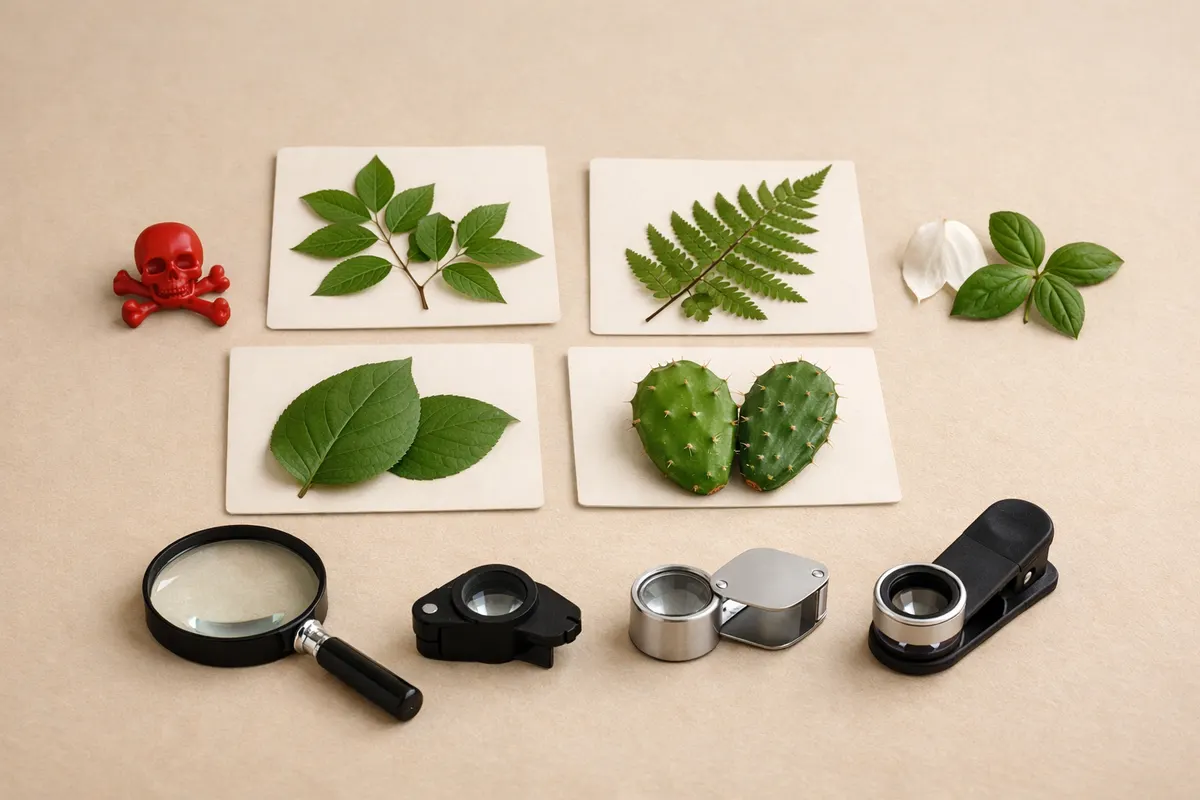
Quick answer for leaf shape identification
Leaf shape identification works best when the image shows the leaf plus the stem it grows from. Start with outline, vein pattern, edge margin, and stem arrangement, then add the whole plant habit, flowers, fruit, bark, or habitat when available.
A single clear image can often narrow a plant into a useful shortlist, but one photo rarely proves species or safety. Treat quick IDs as research notes and look for diagnostic details such as flowers, fruits, bark texture, or venation before acting on the result.
Use these quick checks to decide what additional photos to take before running a first pass with Leafzy. If the plant could be hazardous, allergenic, invasive, or regulated, pause and seek verification from a trained local source after note-taking.
- First: capture the whole plant, not only one cropped leaf.
- Second: compare leaf shape, margin, veins, and arrangement together.
- Third: add flowers, fruits, bark, growth habit, and habitat for confirmation.
What leaf shape can and cannot identify
When people search for leaf shape identification, they usually want to turn visible leaf clues into a practical shortlist. A good leaf photo can show outline, venation, margin shape, surface texture, and sometimes stem attachment, but it cannot always prove the exact species by itself.
These categories are not taxonomic ranks; they’re descriptive. For example, 'shrub' and 'tree' both describe woody growth forms, but closely related species can appear as either form depending on environment (a stunted tree in alpine conditions vs a tall shrub in a sheltered valley). That’s why visual clues and context matter more than the label itself.
In practice this means you should use the plant type label as an entry point to diagnostic features. If you determine the plant is a grass-like species, you’ll prioritize blade shape, ligules, and seedheads. If it’s a woody tree, you’ll focus on leaf arrangement, bark, and mature fruit or cones.
- Categories are descriptive, not definitive taxonomic labels.
- The same species can appear different under varying conditions.
- Use the type to guide which diagnostic features to collect next.
Key clues
Here are the strongest visible or contextual clues that quickly improve leaf shape identification. For each clue I’ve added what it typically points toward and why it matters for narrowing identifications.
1) Woody vs non-woody: Scratch or look at the stem. A persistent woody stem with bark or corky ridges usually indicates a tree, shrub, or woody vine. Soft, green, and seasonally dying stems usually indicate an herbaceous forb or annual.
2) Growth habit and size: A single main trunk reaching several meters indicates a tree. Multi-stemmed, lower-to-the-ground woody plants are shrubs. Low mats or rosettes often indicate groundcover herbs or succulents. Climbing stems with tendrils or aerial roots are vines.
3) Leaf arrangement and type: Alternate, opposite, or whorled leaf arrangement (and whether leaves are simple or compound) quickly eliminate many lookalikes. Parallel-veined narrow leaves point to grasses and sedges; net-veined broad leaves point to many dicots (trees, shrubs, forbs).
4) Reproductive structures: Flowers, inflorescences, seed pods, cones, and berries are often the most diagnostic features. Even a single small fruit can confirm whether a plant is in the rose family, legume family, or a conifer.
5) Habitat and season: Where the plant is growing (wetland, roadside, forest understory, lawn) and the time of year constrain possibilities. Many plants have juvenile forms that look very different from mature specimens.
6) Additional surface clues: Presence of hairs, milky sap, prickles or thorns, and smell when crushed are high-value details. For succulents, leaf thickness and whether leaves are stacked or rosetted are key.
- Woody vs non-woody (tree/shrub vs herb/vine)
- Habit: trunk, clump, rosette, mat, trailing
- Leaf arrangement: alternate, opposite, whorled; simple vs compound
- Venation: parallel (grasses) vs reticulate (broadleaves)
- Flowers, fruit, cones: often species-level clues
- Habitat and phenology: restrict likely species
Step-by-step workflow
Turn the clues above into a short workflow you can follow in the field and with your phone camera. This process reduces wasted images and gives any identification (app or human) the context it needs.
Step 1 — Initial scan: From a few meters away, take a wide photo that shows the whole plant and immediate surroundings. Note height, whether the plant is solitary or clumped, and the substrate (rock, soil, or pot). This places the specimen in a type category quickly (tree, shrub, groundcover, etc. ).
Step 2 — Leaf and stem detail: Take close-up photos of a single leaf (both upper and lower surfaces if possible), a full compound leaf (to show leaflet arrangement), and the stem at a node (to show whether leaves attach via petiole or are sessile). Include a common object (coin, ruler) for scale.
Step 3 — Reproductive parts and habit: Photograph any flowers, buds, fruits, seeds, cones, or seedheads. Capture the arrangement (clusters, spikes, panicles) and color. If the plant climbs, show attachment points (tendrils, twining, rootlets).
Step 4 — Additional context: If present and safe to sample, note scent by crushing a leaf on a tissue and testing, note sap color (clear, milky), and take a photo of bark or older stems for woody plants. Record location and date — geographic range and season narrow options.
Step 5 — First-pass ID and verification: Use the collected photos to run a first-pass with tools like Leaf Identification: Leafzy, but treat the output as a research note. Compare the top suggestions against your photos and the most diagnostic clues (flowers, fruit, leaf arrangement). If suggestions are uncertain or the plant could be hazardous, contact a local extension service, nursery, or botanist for confirmation.
- Wide shot first, then progressive close-ups (whole plant → leaf → stem → flower/fruit)
- Always include scale and habitat context
- Use app results as leads, not final confirmations
Examples
Example 1 — Backyard shrub with red berries: A multi-stem woody plant about 1.5 m tall, alternate compound leaves with serrated margins, and clusters of red drupes in late summer points toward a shrub in the rose family (Prunus) or similar genera. Key next photos: close-up of an open fruit, leaf underside, and bark. If berries are eaten or handled, avoid contact until verified.
Example 2 — Lawn plant that looks like grass vs sedge: Narrow leaves with parallel veins are grass-like. Check the stem cross-section (grasses are round and hollow between nodes; sedges have triangular stems—'sedges have edges'). Photograph the ligule (tiny flap at the blade base) and any seedheads. This set of images quickly separates grass, sedge, and rush candidates.
Example 3 — Houseplant mistaken for succulent: Thick leaves in a rosette might suggest a succulent, but some aroids and bulbous plants also have thick leaves. Photograph the leaf base and entire rosette, note whether leaves are fleshy to the touch, and capture the base of the stem (is there a bulb, rhizome, or cane? ). These details decide between succulent type and broadleaf houseplant.
Example 4 — Young tree vs shrub: A young tree in a small yard may appear shrubby. Look for a single dominant stem or developing canopy-supported limbs; photograph the base and the highest point you can. Mature reproductive parts (buds, flowers) may not be present on juveniles; in that case, bark texture and leaf arrangement are the most useful clues.
- Shrub with berries: focus on fruit and leaf margins
- Grass-like plants: check stem cross-section and ligule
- Succulent lookalikes: check leaf thickness, stem base, and storage organs
- Young trees: look for single dominant stem vs multi-stem habit
Limitations
Separate high-confidence from partial and uncertain outcomes. High-confidence: you can place a plant in a type (grass vs tree vs succulent) from habit and leaf form; many apps and experts will agree on type-level classification from good photos. Partial confidence: you can narrow to a genus or family with clear reproductive parts and leaf arrangement. Uncertain: juvenile forms, sterile specimens, cultivars, and species with wide morphological variation often resist photo-only identifications.
One image rarely proves safety, edibility, value, or legal status. Never assume a plant is safe to touch or eat based on a single photo or an app suggestion. For anything that could be poisonous, allergenic, or regulated (certain invasives and protected species), follow up with a qualified local source: county extension, conservation agency, university herbarium, or licensed professional.
Biological complexity: hybrids, cultivars, and plants grown under atypical conditions can show traits of multiple types. Also, seasonal changes (leafless winter forms, ephemeral spring flowers) mean some diagnostic features aren’t always available. When an identification has high consequence—human health, livestock, or legal compliance—seek in-person verification.
Practical verification steps: take multiple photos across seasons if possible; preserve a sample properly if allowed and safe (for herbarium or lab work); and keep geotag and date metadata with your images. Use app suggestions as starting points and document why you accept or reject a suggested match before taking action.
- High-confidence = type-level label (tree, grass, succulent) with good photos
- Partial confidence = genus/family possible with reproductive parts
- Uncertain = sterile or juvenile specimens, hybrids, cultivars
- For safety or legal issues, always verify with a qualified local source
Related guides
Next step — use Leaf Identification: Leafzy as a first pass
After you’ve followed the checklist and taken the recommended photos, use Leafzy on your phone to generate first-pass suggestions. Treat app results as research notes: compare them to your reproductive-part photos and habitat observations, and if a match could affect health, livestock, or legal matters, verify with a local expert before acting.

Frequently asked questions
What photos help most for leaf shape identification?
Capture the whole plant, a close-up of one leaf, the stem node where leaves attach, the underside of the leaf, and any flowers, fruit, seedheads, bark, or habitat context. A scale object helps separate similar-looking seedlings, shrubs, grasses, and vines.
How many photos do I need to identify a plant type reliably?
For a reliable type-level ID, aim for 3–6 photos: a wide shot of the whole plant, a close-up of a leaf (with underside if different), a stem or node shot, and a photo of any flowers or fruits if present. Include scale and habitat context. More photos increase confidence, especially for species-level identifications.
Can I identify a plant from a single leaf photo?
A single leaf photo can often indicate the plant type (for example, whether it’s a grass, compound-leaf shrub, or succulent) but usually isn’t enough to confirm species or safety. Leaf-only images miss crucial reproductive and habit information, so treat single-photo IDs as hypotheses to test with additional photos and context.
What should I do if I suspect a plant is poisonous or hazardous?
If you suspect a hazardous plant, avoid contact, keep pets and children away, and do not taste or handle parts. Use photos to document the plant from multiple angles, then seek verification from a trusted local resource (county extension, poison control, certified arborist, or university botanist). For immediate exposure concerns, contact your local poison control center or emergency services.