
Stinging Nettle
By Celia North
Compare the pointed tips, toothed edges and branching veins in a stinging nettle scan. See which photos help you check a possible nettle in early spring.
Identification summary
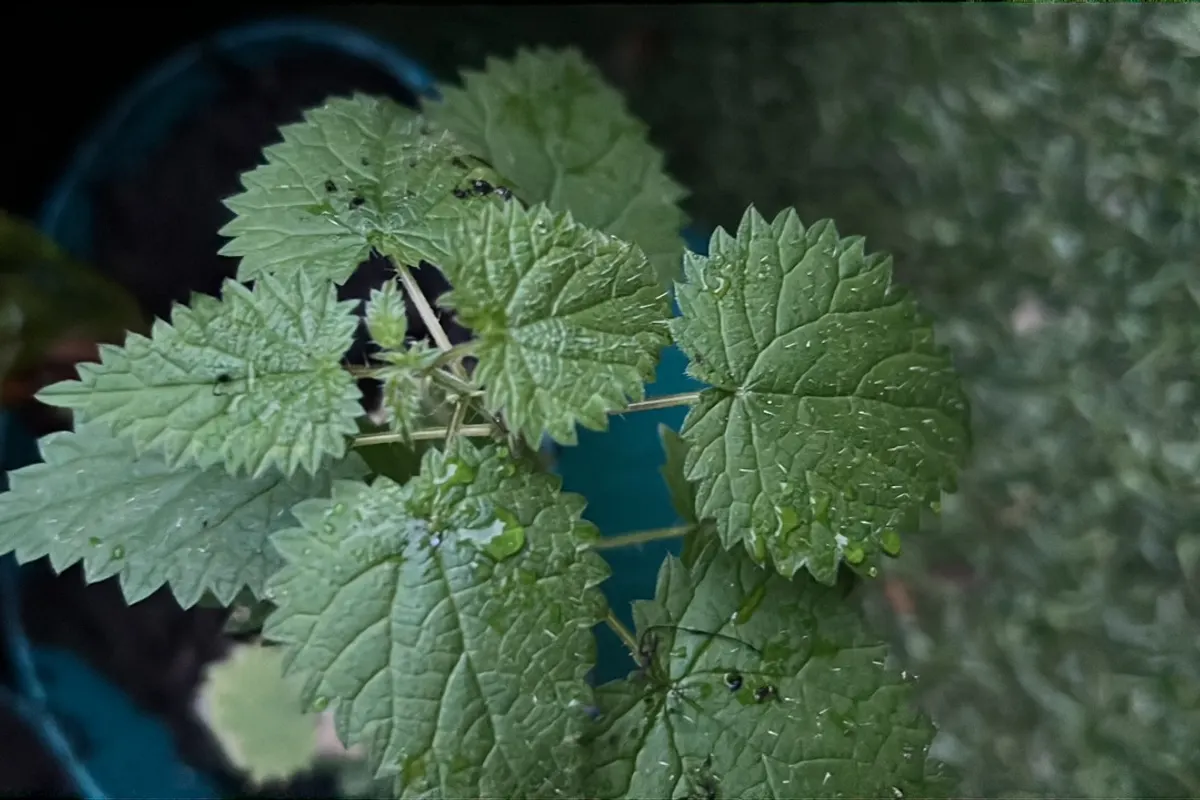
Leafzy returned “Stinging Nettle” for this photograph. Look at one of the larger leaves. Its edge has a row of sharp teeth and its veins branch toward the margin. The same features are visible on several leaves around the shoot.
The scan was recorded on October 11, 2026. It is a reference for comparing leaf shapes when early spring weeds are coming up. The growing location, capture date and growth stage of the photographed plant were not recorded separately.
Identification
| App result | Stinging Nettle |
|---|
Visible features
| Leaf edges and tips | Repeated sharp teeth and pointed tips on several green leaves |
|---|---|
| Veins | Branching veins visible across the larger leaf blades |
Next observation
| Stem node | A side view could show whether two leaves attach at the same height on opposite sides of the stem. |
|---|
Start at the leaf edge
When looking at early spring weeds, pick one whole leaf to follow from its stalk to its tip. In this photograph the outline is easiest to read where a leaf crosses the dark background. The teeth repeat along both sides. Several blades narrow to a pointed tip. Water droplets catch the light on the surface, but the teeth remain visible in the silhouette.
These observations fit the scan’s stinging nettle suggestion. They also give you something specific to compare with your own plant. A single tooth or a patch of rough-looking surface carries little weight. Check whether the same pattern repeats on another fully opened leaf. Leave the tiny folded leaves at the center for later because their edges are harder to read.
Follow two leaf stalks back to the stem
In weed identification, “opposite” describes where the leaf stalks attach. Two leaves belong to an opposite pair when they meet the same stem at the same height, one on either side. Two blades can point away from each other in an overhead picture even when they attach at different heights.
Here several stalks converge behind overlapping leaves. A side photograph taken level with one junction would show the attachment more clearly. Compare it with the stem and leaf photographs in the Iowa State University Extension stinging nettle profile (https://crops.extension.iastate.edu/encyclopedia/stinging-nettle).
Stinging nettle can carry hairs that irritate skin. Use the camera zoom and move around the plant to line up the shot. Leave the stem and leaves in place. The bright specks in this image do not resolve individual stinging hairs clearly enough to use them as an identification feature.
What to photograph on a spring walk
Take one picture of the whole shoot where it emerges from the ground and one close view of a leaf junction. The first view preserves the overall shape and helps you follow the same stem in a crowded bed. The second lets you compare one pair of leaves with the pair just above it. Record the date and location of your own observation. The date on this October scan tells us nothing about when a similar plant first appeared in your garden.
If the shoot is too small to show a clear junction, return when another pair of leaves has opened and photograph it from the same side. Keep the first picture for comparison. The plant identification cheat sheet has examples of other details worth noting (https://leafidentification.app/blog/plant-identification-cheat-sheet).
More Weed Identification identifications
Related guides
Compare your own weed photo
Choose the view where the leaf edge and its attachment are clearest. Submit it to the Leafzy weed identifier and compare the suggested plant with your whole-shoot photograph. https://leafidentification.app/tools/weed-identifier
Take the next step →Frequently asked questions
Which clue is clearest in the nettle scan?
The repeated sharp teeth around several leaf blades are easy to see. Their pointed tips and branching veins are also visible. A side view would give stronger evidence about where the leaves attach.
Was this particular nettle scanned in early spring?
The app recorded the scan on October 11, 2026. Its location and the date the photo was taken are unknown. The picture illustrates features you can look for on your own spring plants.
Should I touch a leaf to check for a sting?
Keep your hands clear. Photograph the plant from the side and compare its leaf arrangement with a regional identification guide. A skin reaction is unnecessary for this check.
Can I use the scan result to decide whether to eat this plant?
No. A photo and an app suggestion are insufficient for a foraging decision. Leave an uncertain plant unharvested.