Leaf Identification
Poison Ivy: Identification, Habitat, and Real Examples
Recognize poison ivy from photos with leaflet, vine and colour clues, lookalike checks against Virginia creeper, and when you are likely to meet it.
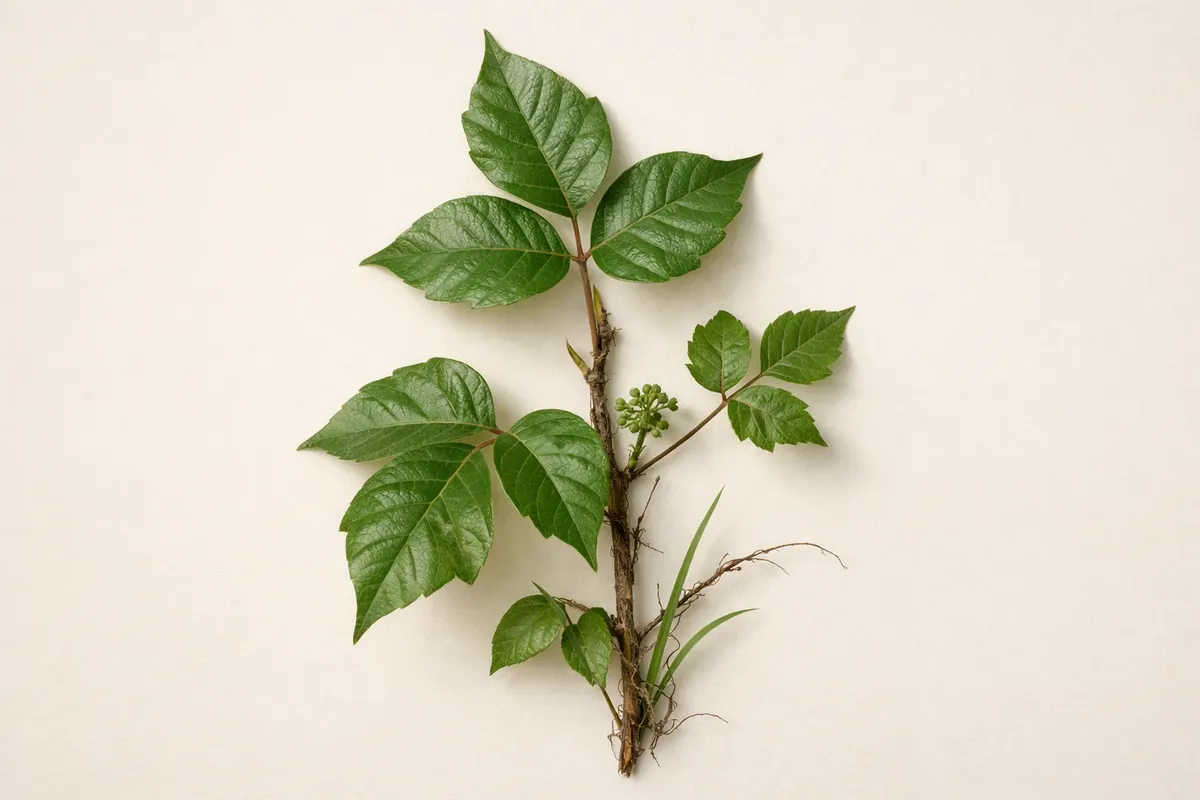
What poison ivy is and where it grows
Poison ivy (Toxicodendron radicans in most of North America) is a variable perennial plant that appears as a woody vine, low shrub, or trailing groundcover depending on region and habitat. It contains urushiol, an oily compound in leaves, stems, and roots that causes allergic skin reactions in many people. Seeing three leaflets is its most famous trait, but growth form and color change by season and age.
In woodlands, fence rows, and disturbed ground you’ll commonly find poison ivy climbing trees by hairy aerial roots or spreading as stem fragments on the ground. Mature vines can develop a brown, furrowed bark, while juvenile vines stay green and flexible. Its flowers are small and inconspicuous; fruit are smooth, white or cream drupes that persist into fall and feed birds.
Because appearance varies with location and season, identifying poison ivy combines leaf detail, vine or stem habit, and context (is it climbing, trailing, or a stump-sprout?). This page focuses on photo-checkable features a non-specialist can use, and explains what a single photo can and cannot confirm.
How to identify poison ivy
Key photo clues start with the compound leaf pattern: clusters of three leaflets borne on a single petiole is the simplest and most consistent signal. Look at the full leaf group — a single photo that includes the stem, the base of the leaflets, and at least one node is much more useful than a cropped close-up of a single leaflet.
Examine leaflet shape and margins. Poison ivy leaflets vary from smooth-edged to toothed or lobed; the terminal (center) leaflet often has a longer stalk than the side leaflets. Surface texture ranges from glossy new growth to dull, leathery mature leaves. Color shifts seasonally — shiny green in spring and summer, yellow, orange, or red in fall — so color alone is not definitive.
Stem and vine cues are helpful: climbing vines commonly show hairy aerial rootlets; thicker, woody vines develop a coarse, braided bark. When present, clusters of small white berries and remains of tiny greenish flowers support an identification. Always photograph multiple angles: top and underside of a leaflet, the junction where leaflets meet the petiole, and any rootlets or berries.
- Three-leaflet arrangement: single petiole with a group of three leaflets is the core signal.
- Asymmetry and terminal stalk: the middle leaflet usually has a longer stalk than the lateral ones.
- Variable margins: smooth, notched, or lobed edges can all occur on poison ivy.
- Climbing habit: hairy aerial rootlets on vines or a braided brown bark on older stems.
- Fruit and flowers: small white berries and tiny clustered flowers (spring–summer) when visible.
Key facts
This quick table lists attributes you can check in photos and short notes on what each visible trait usually indicates. Use the table to compare multiple photos from different angles — single-image uncertainty is common because morphology varies by region and season.
When photographing for comparison, include scale (a coin or ruler), a shot showing the whole growth habit (vine, shrub, or groundcover), and at least one close-up of leaflets and stem junctions.
| Attribute | Typical | Photo notes |
|---|---|---|
| Scientific name | Toxicodendron radicans (most cases) | Use locality notes — related species exist in some regions |
| Leaf arrangement | Alternate; compound leaves of three leaflets | Capture entire leaf group including petiole |
| Leaflet shape | Variable: smooth, toothed, or lobed | Shape varies by plant age and sunlight exposure |
| Stem and vine | Climbing vine with hair-like rootlets or woody vine | Photograph rootlets and bark texture for stronger ID |
| Flowers & fruit | Small greenish flowers; white/cream berries | Berries persist into fall and help confirm ID |
| Habitat & season | Woodland edges, fences, disturbed ground; seasonal color change | Context shots (soil, nearby trees) add useful clues |
Where and when you'll run into poison ivy
Poison ivy is an edge plant. Toxicodendron radicans covers most of the eastern and central United States and southern Canada, while the shrubbier Toxicodendron rydbergii takes over through the northern plains and mountain west; neither grows in Hawaii or most of Alaska, and along the Pacific coast you are far more likely to meet its relative, Pacific poison oak. Look for it where light and disturbance meet: trail margins, fence rows, stone walls, riverbanks, roadside ditches, and the untended back edge of a yard. In the same stand it will both climb tree trunks on hairy aerial rootlets and sprawl across the ground.
Timing changes what you see, not the risk. New leaves unfold reddish in mid-spring, turn glossy green through summer, and flare orange to scarlet in early fall, when the plant is the easiest to spot all year. After leaf drop the bare, hairy vine is still poison ivy, and every part of it holds urushiol year round, roots and winter stems included. The oil transfers from tools, gloves, boot laces, and pet fur long after contact, and burning brush carries it in the smoke, so brush clearing, firewood cutting, and trail work count as exposure occasions just as much as a summer walk.
| Season | How it usually looks | Where you are most likely to meet it | Exposure to watch for |
|---|---|---|---|
| Spring (Apr-Jun) | New three-leaflet growth, often reddish and glossy | Garden borders, fence lines and trail edges leafing out | Weeding and bed clean-up with bare forearms |
| Summer (Jun-Aug) | Full green leaflets, small greenish flower clusters, vines climbing trunks | Woodland edges, riverbanks, campsites, overgrown lots | Brushing past vines on narrow trails; string-trimmer spray |
| Fall (Sep-Nov) | Orange to deep red leaflets and white or cream berries | The same edges, now obvious against still-green foliage | Raking and clearing; urushiol left on tools and gloves |
| Winter (Dec-Mar) | Leafless, hairy rope-like vines on trunks and bare stems | Tree trunks, fence posts, brush piles and woodpiles | Cutting or burning brush - the smoke carries urushiol |
Plants commonly mistaken for poison ivy
Several plants share superficial traits with poison ivy; a careful photo comparison of leaflet count, attachment, and vine habit usually separates them. Below are the most frequent lookalikes and the specific photo clues that help tell them apart.
When in doubt, prioritize features a photo can capture: whether leaflets are in true compound groups attached to a single petiole, whether a vine has aerial rootlets, and whether fruit or flower clusters are present.
- poison ivy vs virginia creeper — Virginia creeper has five (sometimes seven) palmate leaflets, not groups of three; a full-leaf photo showing leaflet count resolves this confusion quickly.
- Box elder seedling or some maples — juvenile compound leaves can appear similar; check leaflet number and vein pattern and look for opposite leaf arrangement in maples (poison ivy is alternate).
- Raspberry or blackberry shoots — these can have compound leaves, but stems usually have thorns and the leaflets come in different numbers and textures.
- Wild grape vine — grape leaves are single and typically lobed with a cordate base, whereas poison ivy has distinct three-leaflet compound leaves.
Care, handling, and safety around poison ivy
Because urushiol causes allergic reactions, handling poison ivy requires precautions. Wear gloves, long sleeves, and wash clothing and tools after contact. If you plan to remove or transplant plants, follow local guidance about disposal: burning or composting can spread urushiol if not done properly.
For photograph-based comparison, avoid touching the plant and use a long lens or extendable phone grip to get close shots. Label images with date and location and wash hands and equipment promptly. If you develop a rash after suspected contact, seek medical advice — severe reactions sometimes need professional treatment.
Frequently asked questions
What does poison ivy look like when it climbs a fence?
When poison ivy climbs a fence it usually shows vine stems with hair-like aerial rootlets that cling to wood, and repeated clusters of compound leaves each with three leaflets. Leaves can be glossy or dull depending on age; in fall they may turn orange or red. Photograph multiple segments: the rootlets, a whole leaf group, and any fruit to increase confidence.
How can I tell whether a roadside vine is poison ivy or a harmless creeper?
Start by counting leaflets: poison ivy typically has three leaflets per leaf group, while many harmless creepers have five or differently arranged leaves. Look for hairy rootlets on climbing vines and for white berry clusters. Capture clear photos of the leaf base where leaflets meet the petiole and a shot that shows the vine’s overall habit to compare against identification clues.
Is poison ivy vs virginia creeper a common problem when clearing brush?
Yes — volunteers and gardeners often confuse the two because both can climb and produce viney growth. The decisive difference is leaflet count: Virginia creeper usually has five (sometimes seven) palmate leaflets attached at a single point, while poison ivy has three leaflets in a compound leaf. Use gloves and treat unknown vines as potentially irritating until confidently identified.
Can a single photo confirm a plant is poison ivy?
A single well-composed photo that shows the full leaf group, the petiole junction, stem/rootlets, and any fruit can strongly suggest poison ivy, but it is not proof. Seasonal variation, juvenile forms, and regional lookalikes can introduce doubt. Use multiple angles and contextual shots, and treat photographic IDs as a first pass rather than definitive verification.
Related guides
Compare your photo with Leaf Identification: Leafzy
Use Leaf Identification: Leafzy on your phone to compare a photo of the plant against the visual clues on this page. Scan multiple angles—leaflet groups, stem junctions, and any berries—and treat the app’s result as a helpful first pass. For safety and certainty, combine app guidance with the field checks above or consult a local botanist when necessary.