Houseplant Leaf Identification: Shape, Texture, and Growth Clues
Learn which leaf details photos can reliably show, which clues are weak, and practical next steps for houseplant leaf identification before you trust a match.
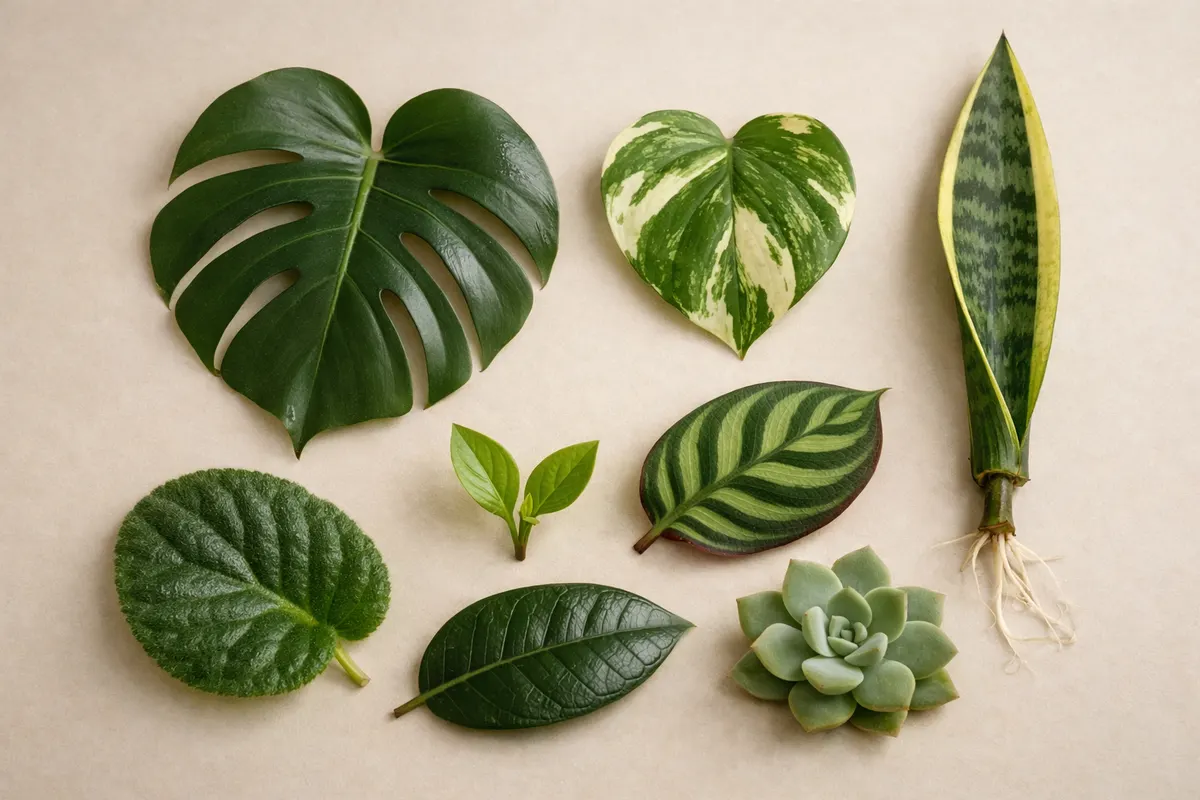
Quick answer: what photos can tell you about a leaf
Houseplant leaf identification starts with realistic expectations: a single phone photo can confirm several durable features—leaf shape, margin type, venation pattern, texture hints, and relative size—while it usually cannot prove species-level identity on its own. Look for structural clues that don't change with light or slight leaf damage; those are the strongest evidence you can extract from an image.
When you examine a photo, prioritize traits the camera records reliably. Leaf outline (oval, lobed, lanceolate), edge pattern (serrated, smooth, wavy), and clear vein arrangements often survive common photo problems like soft focus or color shifts. Paired with growth habit cues—cluster arrangement, node position, and whether leaves are opposite or alternate—these features narrow the field to a handful of likely genera.
Even with solid clues, treat a photo-based identification as a working hypothesis, not a final certificate. Use the image to reduce options and guide follow-up checks: better photos from different angles, a shot of the stem and node, or a picture including scale like a coin. If uncertainty remains, the app Leaf Identification: Leafzy can be a helpful next step to aggregate likely matches, but avoid assuming a single photo gives a definitive label.
houseplant leaf identification clues that hold up in photos
The most dependable clues are structural features the camera records regardless of color shifts or modest blur. Start with leaf shape: is the blade broadly oval, narrowly lance-shaped, heart-shaped, or deeply lobed? Shape is usually consistent across developmental stages within a species and helps eliminate large groups quickly. For example, a clearly lobed blade with deep sinuses points you toward genera like Fatsia or some Aralia relatives, while long narrow lanceolate leaves suggest dracaena-type plants.
Next, inspect venation. Pinnate venation (one main midrib with branching side veins) and palmate venation (several primary veins radiating from the leaf base) are strong signals. A photo that captures veins running from the midrib to the margin or a fan of veins from the base can separate lookalikes—contrast, for instance, a philodendron with pinnate-like veins from a palmiform species with parallel veins.
Leaf margin and apex are compact, high-value clues. A serrated edge, pronounced teeth, or crenate margin is usually visible even in average phone photos. The leaf tip—rounded, acuminate (tapering), or mucronate (tiny abrupt point)—is another stable trait that narrows candidates when combined with shape and venation.
Texture and surface features matter when visible. A glossy, thick cuticle versus a matte, thin leaf surface signals different plant families. Hair (pubescence) on the upper or lower surface, visible scale-like textures, or a powdery bloom can be decisive for certain groups like Tradescantia or African violets. Note: texture cues work best when lighting reveals surface reflectance rather than washing it out.
Growth context gives high leverage. How leaves are attached to the stem—petiole length, the presence of sheathing bases, or whether leaves arise from a rosette—helps differentiate species that have similar leaves but different habits. If a photo shows a cluster at the top of a cane, that pattern points to certain genera; evenly spaced alternate leaves suggest others.
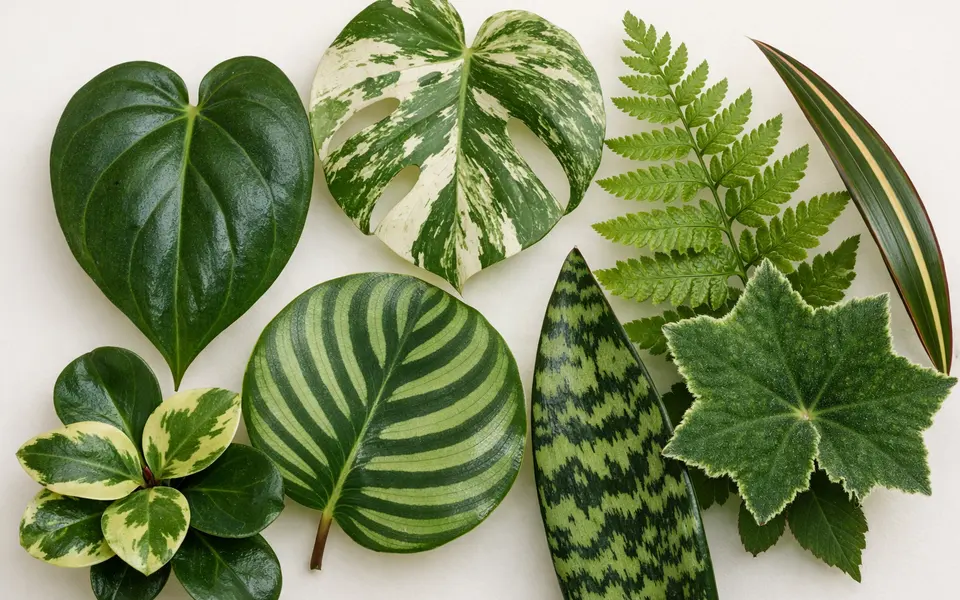
- Shape categories to check first: ovate, elliptic, lanceolate, cordate (heart-shaped), and lobed.
- Venation clues: palmate (fan), pinnate (feather-like), parallel (grasses and some palms).
- Margins: serrated/ toothed, entire (smooth), crenate (rounded teeth), or undulating (wavy).
- Attachment and habit: petiole length, opposite vs. alternate leaves, rosette vs. cane growth.
- Surface features: glossiness, hairs, scales, powdery bloom, and raised midrib texture.
Weak signals
Some features are tempting to use but are unreliable from a single photo. Color is the classic weak signal: lighting, white balance, and age can shift hues dramatically. A leaf that looks chartreuse in warm indoor light might be deeper green outdoors; variegation can be washed out by backlight or confused with sunscorch. Don’t let color alone drive an identification.
Surface reflections and glare are another trap. Shiny leaves can reflect highlights that hide vein patterns or margin detail. Similarly, shadows can mask lobing or create false apparent serrations. When you see high-contrast highlights or deep shadows, note that the apparent texture and margins may be artifactual.
A single angle hides three-dimensional cues important for ID. Curling leaves, overturned margins, and the relationship between upper and lower surfaces are invisible from only a top-down shot. Likewise, juvenile leaves often have different shapes or variegation patterns than mature leaves, so matching a young-leaf photo to an adult reference can mislead.
Context-free closeups are risky without scale and plant habit. A cropped image of an isolated leaf loses node position, stem thickness, and whether leaves are basal or cauline—information that frequently separates lookalikes. Whenever possible, include a contextual shot and a detail shot; together they offset many weak signals.
- Color alone changes with light and is a poor primary ID trait.
- Glare and shadows can create false texture and hides veins.
- Juvenile vs. mature leaf forms can be misleading if not noted.
- Closeups without scale or habit remove essential context for ID.
How to compare likely matches using multiple clues
A systematic comparison workflow collapses uncertainty quickly: list the two to five most plausible genera or species, then test each candidates against independent clues you can check in or near the photo. Don’t try to confirm identity with a single matching trait; instead look for a constellation of compatible features—shape, venation, margin, surface, and growth habit—that collectively fit one candidate better than the others.
Start by making a short checklist from the strongest clues you observed: leaf shape, primary venation type, margin type, presence of hairs or scales, and whether leaves are opposite or alternate. For each candidate, mark whether the feature is required (present in all members), common (often present), rare (uncommon), or contradictory. Candidates with multiple contradictions move lower in probability.
When sources disagree, weigh structural clues higher than color or pattern. For example, two species might share similar variegation but differ in venation and leaf attachment; if your photo shows the latter clearly, prioritize that trait. Use a secondary check of growth habit and stem details whenever possible: a matching leaf plus a matching stem node pattern is much more convincing than a leaf match alone.
If you want a quick comparative reference, the Plant Identification Cheat Sheet collects the same visual checks into an ordered workflow that many hobbyists find useful. It’s a practical complement to this guide when you need a printable checklist or a refresher on lookalike traps.
| Clue | Why it matters | How reliable in a phone photo | Quick follow-up photo to confirm |
|---|---|---|---|
| Leaf shape | Narrows genus groups by blade outline | High | Full-leaf shot with margin visible |
| Venation pattern | Separates palms/monocots from dicots | High if veins are visible | Overlay light from side to show veins |
| Margin type | Eliminates many lookalikes | High unless blurred | Close-in shot of leaf edge |
| Attachment/habit | Confirms growth habit differences | Medium, needs context | Shot showing stem and node |
| Surface texture | Points to family-level groups | Medium, affected by glare | Oblique light photo to show gloss or hairs |
- Build a 3–5 candidate list from initial clues, then score each candidate against independent features.
- Prioritize structural traits (shape, venation, margin, attachment) over color or surface patterns.
- Use node/stem photographs as tiebreakers when leaf traits alone give multiple matches.
- Record contradictions: features that clash with a candidate lower its likelihood quickly.
Using Leaf Identification: Leafzy after checking visual clues
Once you’ve gathered structural clues and at least one contextual photo, using an identification app makes sense as a next step. Treat the app as a triage tool: it compiles likely matches and highlights which features align and which do not. That helps focus your follow-up photos and searches rather than replacing the observation checklist you already used.
When you open Leaf Identification: Leafzy, feed it the best representative images you have: a full-leaf shot showing shape and margin, a close edge shot showing serration or smoothness, and a context shot showing stem, nodes, or growth habit. The app’s suggestions are most useful when they corroborate multiple independent clues from your checklist; single-trait matches are weak evidence by themselves.
Leafzy can help surface lookalike candidates you may not have considered and provide visual references to compare against your photos. If the app lists several plausible matches, return to the comparison workflow: score each candidate against venation, attachment, and texture. Use app suggestions as research notes, not final determinations—especially when consequences matter, such as toxicity or care requirements.
If you want a short printable checklist, consult the Plant Identification Cheat Sheet for a clear ordering of clues and common lookalikes. That resource pairs well with the app’s candidate list and helps you decide which additional photos will most improve confidence.
- Use at least three photos: full-leaf, edge detail, and context (stem/node).
- Compare app candidates against your structural checklist; prioritize matches with multiple agreeing clues.
- Treat app results as guided suggestions and gather more evidence for any high-consequence identification.
- Use the app to reveal lookalike species and to target the most informative follow-up photos.
Related guides
Try Leaf Identification: Leafzy after your clue checklist
When you’ve checked shape, venation, margin, and habit, use Leaf Identification: Leafzy as a research tool to gather likely matches and next-photo ideas. Feed the app a full-leaf shot, an edge detail, and a context photo showing the stem or node. Treat the app’s suggestions as starting points: confirm them against the structural clues you recorded, and collect follow-up photos when uncertainty remains. Leafzy helps prioritize possibilities quickly, but final verification benefits from multiple views and, when necessary, expert consultation.

Frequently asked questions
What are houseplant leaf identification examples I can check when leaves look similar?
When leaves look similar across species, use side-by-side examples that highlight persistent structural differences. Good examples include: two plants both with glossy oval leaves where one has a single midrib with pinnate branching and the other shows parallel veins; a heart-shaped leaf pair where one has serrated margins and the other is entirely smooth; or a variegated leaf pair where the variegation appears on mature leaves in one species but only on juvenile growth in the other. When assembling examples, include at least one photo that shows the attachment point or a stem node—those contextual examples often decide between lookalikes.
How do I use houseplant leaf identification clues to tell if a variegated leaf is stable or juvenile?
First, identify the clues: variegation pattern (central, margin, sectorial), presence on multiple leaves, and whether new growth repeats the pattern. Stable variegation usually appears consistently across mature leaves and on successive growth cycles; juvenile or stress-related variegation tends to be irregular, limited to a few leaves, or changes as the plant grows. Photograph new shoots over several weeks and compare; consistent patterning on separate mature leaves is a strong clue that variegation is stable rather than temporary.
Can I identify a houseplant reliably from a single top-down photo of one leaf?
Not reliably. A single top-down photo of one leaf can often let you eliminate many species, but it rarely proves identity because it lacks habit, attachment, and age context. Top-down images are useful for confirming shape and margin, but you should add at least one context shot showing stem and node and a detail shot showing venation or margin. With those supplementary views, your confidence rises substantially; without them, any identification should be considered tentative.
Which photo angles reveal the most useful clues for leaf identification when plants are in low light?
In low light, use oblique light angles to enhance textures and veins rather than trying to correct color. Aim for: (1) a slightly side-lit full-leaf shot to reveal venation and surface texture, (2) a close edge shot with the leaf held flat against a neutral background for margin detail, and (3) a mid-range context photo that includes stem and nearby leaves to capture attachment pattern. If using artificial light, choose a cool, diffuse source to minimize color shifts and glare. These angles preserve structural clues that are less affected by low illuminance.