Leaf Margin Types: Serrated, Smooth, Lobed, and Wavy Edges
Understand leaf margin types with visible clues, durable photo checks, and safe next steps for narrowing likely matches without overstating certainty.
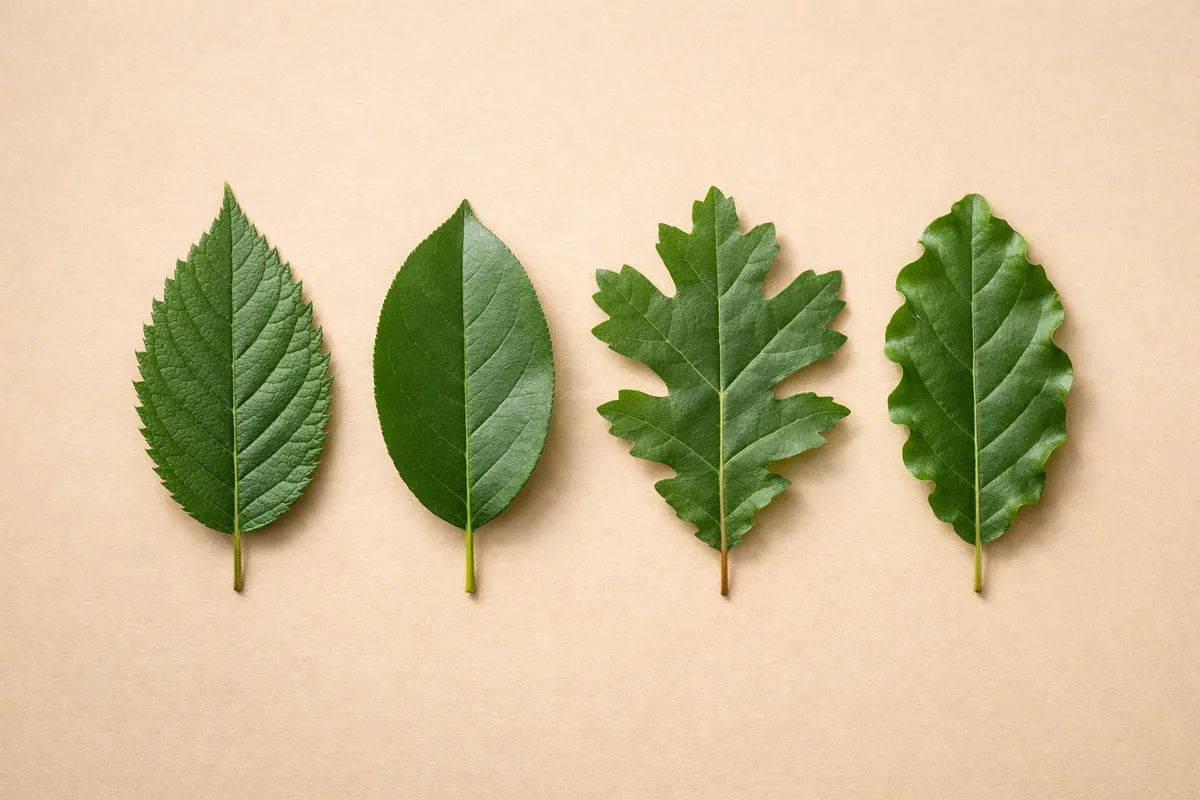
Quick answer for leaf margin types
Leaf margin types are the visible edge shapes of leaves — most commonly serrated (toothed), smooth (entire), lobed, and wavy (undulate). In a well-lit photo you can usually tell these broad categories apart because margin shape is a structural trait: teeth, lobes, and undulations are parts of the leaf blade itself and usually show even when color or texture is distorted.
That said, a single photo rarely proves species identity. Leaf margin types are strong clues for narrowing possibilities but not a final diagnosis. Serrated edges might point to genera like Rosa or Salix, lobed leaves suggest oaks or maples, and undulate margins crop up across unrelated groups, so margin shape is best used with other visible details and context.
Practical rule: treat margin observations as elimination tools. If a leaf clearly has deep lobes with rounded sinuses, you can rule out entire (smooth) or finely serrated taxa immediately. Conversely, if edges are damaged, juvenile, or covered in grit, margin type becomes unreliable and should be treated as a weak signal rather than a decisive clue.
Strongest clues for leaf margin types
Some margin features survive common photo problems like mild blur, backlight, or partial framing. Look first for the overall silhouette: does the leaf outline show regular teeth, lobes separated by deep sinuses, or a gentle wavy edge? The global outline is less affected by small focus issues and gives the most reliable first pass at leaf margin types.
Next, inspect tooth and lobe geometry at higher magnification. Serrated margins often have repeated, roughly similar teeth along the edge; note whether teeth are sharp, rounded, or hooked, and whether they point toward the leaf tip (antrorse) or away. Lobed leaves show larger indentations (sinuses) that interrupt the margin over a scale of millimeters to centimeters — count lobes and note whether lobes are shallow or deep.
Stable supporting clues to record in the same photo are venation at the margin and petiole connection. Veins that extend all the way to a tooth or lobe tip are a strong signal because venation patterns are less variable than surface color. The way the base of the blade joins the petiole (cordate, truncate, attenuate) also helps interpret margin shape: a heart-shaped base plus rounded lobes suggests different candidates than an elongated base with serrations.
Small-scale surface details like marginal hairs, gland-tipped teeth, or glandular dots are excellent strong clues when visible. These features survive in many phone photos if you include a close-up with a neutral background and a small scale (coin or ruler). When you can see hair or gland placement, you move from broad categorization toward useful elimination and comparison.
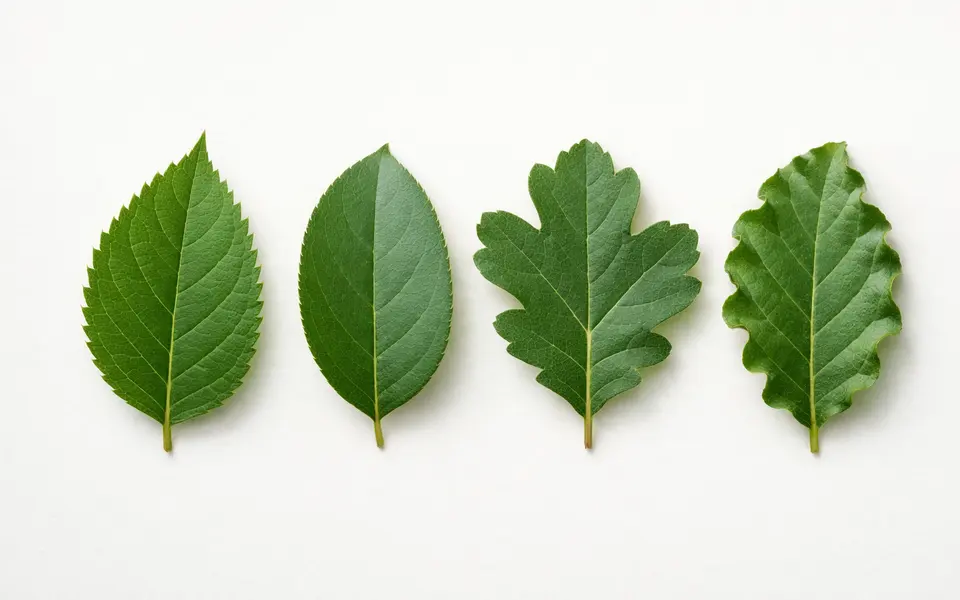
- Overall silhouette: easiest and most reliable clue for classifying margin type.
- Tooth geometry: size, sharpness, and direction help separate serrated subtypes.
- Lobe depth and sinus shape distinguish lobed from shallowly undulate edges.
- Veins reaching teeth or lobes are durable clues visible in close-ups.
- Marginal hairs, glands, or notable teeth shapes are high-value micro-clues.
Weak signals
Color, surface sheen, and a single-angle photo are the weakest clues for leaf margin types. Color varies with season, light, nutrient status, and disease; it rarely correlates directly with margin structure. A bronze or purple leaf might belong to many species with different margins, so color should not override clear shape evidence.
Damage, insect chewing, frost, and herbivory can mimic serrations or mask lobes. For example, repeated insect feeding along an edge can produce notches resembling serration, and torn lobes can make a lobed leaf look irregular or entire. Always inspect multiple leaves or inner, less-exposed foliage to check whether the margin pattern is natural or caused by damage.
Juvenile and sun/shade leaves may show different margin characters on the same plant. Seedlings sometimes have entire leaves while mature stems develop serrations or lobes; similarly, shade leaves may be thinner and less toothed. Relying on a single very young or atypical leaf is a common source of misclassification.
Small size without scale is deceptive: tiny toothed leaves photographed at low resolution can appear smooth, and coarse teeth on a large leaf photographed far away will disappear. If you can’t show a scale reference or crop that preserves edge detail, mark the margin observation as low-confidence.
- Color and sheen: unreliable for margin shape.
- Edge damage and chewing: can mimic natural serration or lobing.
- Juvenile versus adult leaves: margin traits can change with age.
- No scale or low resolution: teeth and lobes can vanish at small sizes.
Compare leaf margin types step-by-step
A short, repeatable workflow helps compare candidates without overcommitting. Start by assigning the photographed leaf to a coarse margin class (entire, serrated, lobed, undulate). This step typically eliminates many genera at once and focuses which deeper clues matter next.
Next, gather two complementary visual checks: close-up detail of the margin and a contextual shot showing whole-leaf silhouette plus petiole and nearby leaves. Compare how veins approach the margin, whether teeth are uniform, and whether lobes are rounded or pointed. These paired views let you decide whether observed teeth are true serrations or margin damage.
Use habitat and geographic context as soft filters. If the leaf margin suggests an oak-like lobed pattern but the photo was taken in a small herbaceous understory, a herb with lobed leaves is more likely than a mature oak. Similarly, proximity to water or salt spray narrows candidates where certain serrated or entire margins are more common.
Build a short comparison table in your notes: candidate species, margin match (good/possible/poor), supporting clue (vein-to-tooth, hair, lobe count), and confidence level. Even a two-column checklist (candidate / reason to keep or drop) helps keep the process objective. Avoid forcing a single high-confidence ID from margin data alone; instead, use the comparison to prioritize next photos or field checks.
- Classify broadly first, then test with a margin close-up and a whole-leaf shot.
- Compare vein-to-margin relationships to distinguish similar serration patterns.
- Factor in habitat, season, and plant size as soft but useful filters.
- Keep a simple candidate list and use margin clues to eliminate, not assert.
Using Leafzy after checking leaf margins
After you’ve reviewed leaf margin types and recorded the most durable clues, the app can serve as a practical next step for generating candidate matches. Treat the app’s suggestions as hypotheses rather than final answers: margin type helps the app narrow results, but correct identification usually needs multiple confirming characters from flowers, fruit, bark, or repeated leaves.
Take several photos to support a good app pass: a close-up of the margin with a scale, a whole-leaf silhouette, the leaf underside (if accessible), and one contextual shot showing the plant habit and surrounding environment. If the plant is a tree or shrub, include a shot of the twig or bud arrangement. Multiple angles increase the chance the app — and any human reviewer — can verify margin-related clues accurately.
Record short notes alongside the photos: how many lobes you counted, whether teeth point to the tip, and any damage you saw. If the app returns multiple likely matches, use those notes to compare the suggested species and eliminate options that contradict your margin observations.
If you want deeper guidance on combining visual clues beyond margins, our Plant Identification Cheat Sheet walks through a checklist of photos and verification steps (Plant Identification Cheat Sheet: Visual Clues, Similar Lookalikes, and Safe Next Steps: https://leafidentification.app/blog/plant-identification-cheat-sheet). Use that resource to decide whether to seek expert help, collect fruiting material later, or continue with field comparisons.
- Take at least four shots: margin close-up, whole leaf, underside, and context.
- Include a small scale in the margin close-up to preserve tooth detail.
- Annotate photos with observed lobe counts, tooth direction, and damage notes.
- Use app suggestions as starting points and confirm with additional clues.
Related guides
Use Leaf Identification: Leafzy to test margin-based leads
After you’ve documented margin clues, open Leaf Identification: Leafzy on your device to generate candidate matches and turn your observations into testable hypotheses. Capture a margin close-up with a small scale, a whole-leaf silhouette, an underside shot, and a context photo showing plant habit. Treat app suggestions as starting points: compare suggested species against your margin notes, check additional characters like venation or fruiting structures when possible, and mark uncertain results as research notes rather than final IDs. If you need a structured photo checklist before scanning, consult the linked Plant Identification Cheat Sheet to prioritize shots and next steps.

Frequently asked questions
How can I tell serrated from damaged edges in a photo?
Look for regularity and repetition. True serration repeats at a roughly consistent spacing and tooth shape along the margin. Damaged edges are irregular, with ragged tears, inconsistent depths, or localized holes. Check other leaves on the plant: if most show the same tooth pattern, it’s natural; if only outer or older leaves are notched, damage is likely. A close-up showing the tip of a tooth and whether a vein ends at the tip is a decisive indicator for true serrations.
Can juvenile leaves mislead margin classification?
Yes. Juvenile leaves often differ from mature foliage in both margin and overall shape. For example, many eucalyptus and some oaks produce juvenile leaves that are entire or differently lobed compared with adult leaves. When possible, photograph multiple growth stages or leaves from different points on the plant to check consistency. If only juvenile leaves are available, note that margin-based IDs should be low-confidence.
How many leaves or photos should I collect to be confident about a margin type?
Aim for at least three leaves from different parts of the plant and four complementary photos: a whole-leaf silhouette, a margin close-up with scale, the underside, and a habitat/context shot. This set helps confirm whether observed features are consistent across leaves and whether damage or age is influencing margin appearance. More photos increase confidence but remember margin type alone still won’t prove species.
Are there quick lookalikes I should watch for with lobed or undulate margins?
Yes. Some herbaceous plants produce lobed leaves that mimic tree genera (e.g., certain geraniums or nettles with lobed blades), and repeated shallow sinuses can appear undulate from a distance. Also, compound leaves with deeply divided leaflets can be mistaken for lobed simple leaves. Check the venation pattern and whether a petiole divides into leaflets — compound leaves have separate leaflet petiolules — and always inspect the base of the blade to confirm simple versus compound organization.