Leaf Venation Patterns: Parallel, Pinnate, Palmate, and Net Veins
Learn which leaf venation patterns a photo can reliably show, which clues are strong or weak, and practical next steps for careful visual identification.
Quick answer: what leaf venation patterns can show
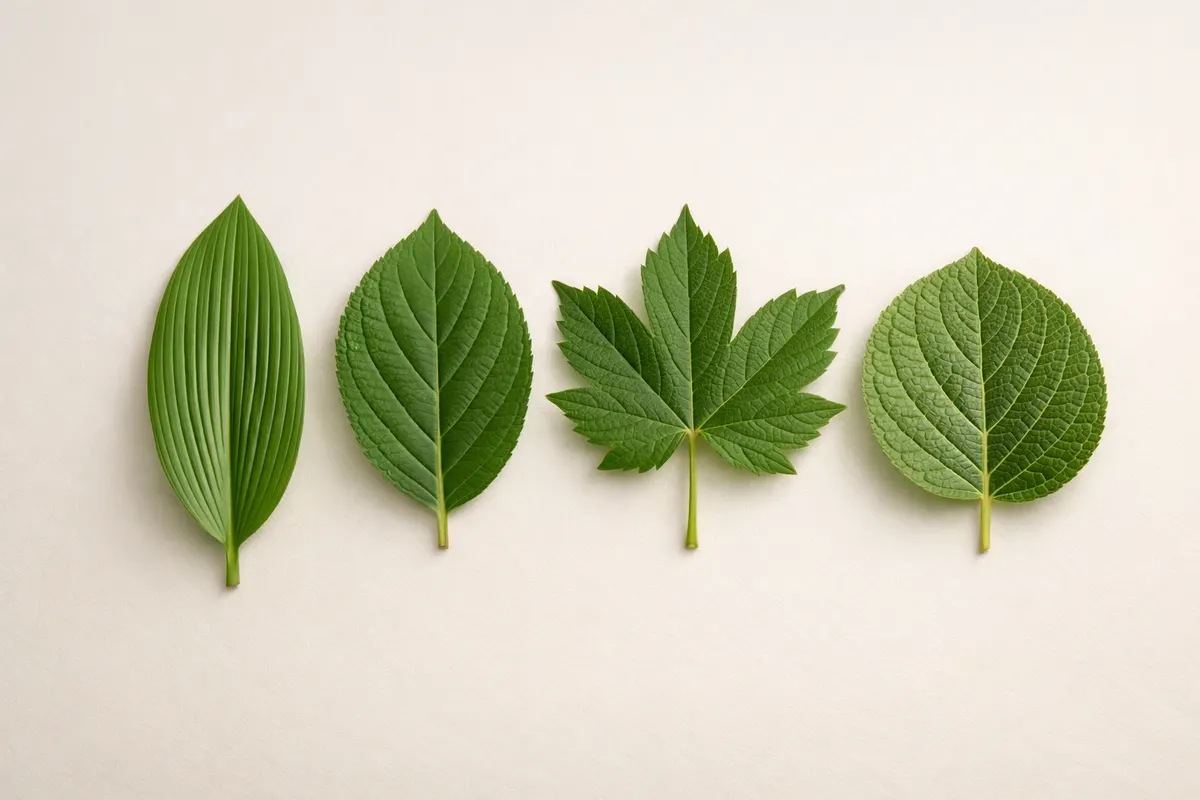
Leaf venation patterns are one of the clearest structural clues you can read from a single photo. Parallel, pinnate, palmate, and reticulate (net) veins describe how the main veins run across a blade and how secondary veins branch. Those patterns are usually visible even in phone photos when the leaf is reasonably flat and well-lit.
What a venation pattern can realistically tell you: it narrows which broad plant groups a leaf belongs to (for example, many monocots show parallel veins while many dicots show net veins). It can rule out obvious mismatches and guide your next comparison steps. It does not, by itself, prove a species—many unrelated plants share similar vein layouts.
If you have one photo, focus on whether the primary veins run side-to-side, branch from a single midrib, radiate from a central point, or form a web of interconnected veins. Those four patterns map to the common terms parallel, pinnate, palmate, and net (reticulate). Combine that observation with leaf shape, margin, size, and context to get a useful ID narrowing.
- Parallel veins: main veins run roughly the length of the leaf with little cross-branching.
- Pinnate veins: one central midrib with secondary veins branching off like a feather.
- Palmate veins: several primary veins radiate from the leaf base or petiole like fingers.
- Net (reticulate) veins: a web of smaller veins forming closed loops or meshes.
- Use venation to exclude broad groups rather than to confirm a species.
Strong visual clues for leaf venation patterns
When assessing leaf venation patterns from photos, prioritize structural clues that survive lighting shifts and minor blur. The arrangement of primary veins is the most robust signal: whether veins run parallel, branch from a single midrib, radiate from a point, or interconnect into a net. These patterns are geometric and harder to misread than subtle color or texture.
Secondary veins and their angle to the midrib are next in reliability. In pinnate leaves, look for a clear midrib with offshoots at roughly consistent angles. In palmate leaves, count the primary radiating veins and note whether they all meet at the petiole base. For net veins, inspect whether the smaller veins form enclosed loops (reticulations) or stay open-ended—looped networks are typical in many broadleaf trees and shrubs.
Vein prominence matters less than pattern. Some leaves have raised veins, others have impressed veins; either can show the same pattern. Also check vein density: very closely spaced parallel veins point to monocots like grasses and lilies, while widely spaced, branching veins are common in many dicots.
Contextual clues strengthen venation evidence. If a leaf with palmate veins grows on a low shrub with lobed blades, that pairing is more meaningful than palmate veins on a tiny seedling leaf. Similarly, knowing whether the plant is herbaceous, woody, aquatic, or a grass-like monocot helps weight certain venation patterns higher in your comparison.
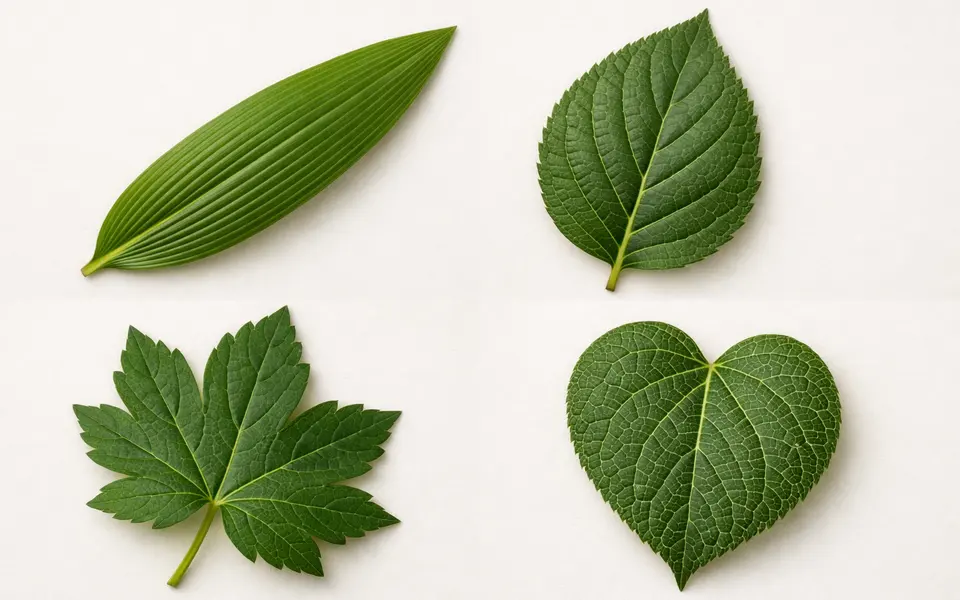
- Primary arrangement (parallel / pinnate / palmate / net) is the most stable clue.
- Secondary vein angle and spacing confirm pinnate vs. net distinctions.
- Vein density helps separate monocots (tight parallel veins) from most dicots.
- Count radiating veins for palmate leaves rather than relying on impression alone.
- Look for closed loops in netted venation—those loops are diagnostic in many species.
- Pair venation with leaf attachment and habit (grass, shrub, tree) for better context.
Weak signals
Some visual cues are tempting but easily misleading. Color, surface gloss, and minor texture features often change with light angle, leaf age, or moisture and should not be used as primary venation evidence. For example, a backlit leaf may highlight thinner veins or create false parallel highlights that mimic parallel venation.
Single-angle or extreme close-up photos can hide the overall arrangement of primary veins. A crop that shows only a midrib and nearby secondaries doesn’t reveal whether those secondaries come from a single midrib (pinnate) or belong to a larger net. Similarly, images taken at an angle can foreshorten veins, making radiating veins look parallel or vice versa.
Damage, disease, or herbivore holes can interrupt vein continuity and create misleading shapes. Young leaves can show juvenile venation that shifts as the leaf expands. Relying on just one of these weak signals increases the chance of a false match; treat them as supporting evidence only.
- Color and sheen: affected by light, not reliable for venation classification.
- Extreme close-ups: risk losing the full vein layout needed for pattern ID.
- Backlighting: may exaggerate small veins and create false parallels.
- Damaged or folded leaves: breaks in veins can suggest the wrong pattern.
- Juvenile leaves may show different venation than mature blades.
Step-by-step workflow to compare venation in photos
Start by establishing the primary venation from the whole leaf: is there one central midrib (pinnate), several primaries from the base (palmate), veins running roughly parallel along the length (parallel), or an interconnected mesh (net)? Use a full-frame photo or step back to capture the whole blade when possible so you can see the overall map of veins.
Next, confirm details that distinguish close patterns. For pinnate vs. net veins, zoom or crop to inspect whether secondary veins regularly join to form loops—if so, you probably have a reticulate (net) pattern rather than strictly pinnate. For palmate leaves, count how many main veins originate at the petiole; three or more clearly radiating primaries point strongly to palmate venation.
Use comparators: pick two or three candidate species or groups and list their expected venation differences side by side. Compare vein count, angle, density, and loop presence across your photos and reference images. Discard candidates that fail on more than one venation trait rather than relying on a single match.
Document uncertainty. If veins look mostly parallel but show occasional cross-bridges, note that result as “parallel-like with cross-connections” and search references for grasses vs. sedges vs. young monocot leaves that sometimes show intermediate features. Treat uncertain results as research notes to guide the next photo or specimen you collect.
- Capture the whole leaf first; smaller crops later for detail checks.
- Classify the primary pattern, then confirm with secondary vein behavior.
- Compare 2–3 candidates side-by-side on vein count, angle, and loops.
- Prefer eliminating mismatches to asserting a single species from venation alone.
- Record ambiguous outcomes and collect additional clues before final ID.
How to use an app after checking venation clues
After you’ve noted the venation pattern and jotted supporting details—leaf shape, margin, size estimate, and a brief habitat note—use Leaf Identification: Leafzy as a structured next step to organize your photos and candidate matches. Treat the app as a way to gather reference images and suggested possibilities informed by the clues you already confirmed, not as a definitive authority.
When submitting images to any identification tool, include at least one clear whole-leaf photo (flat, top view), one close-up of the midrib and secondaries, and a shot showing attachment (petiole or stem) if possible. Since web upload to this site is not supported, use the Leafzy app on your device to add and compare images, or keep the photos in your camera roll while consulting field guides and reference checks.
Compare the app’s suggestions against your venation notes. If the app suggests plants with different primary venation than you observed, treat those results as low-confidence and re-check photos for misread veins or alternative explanations (juvenile leaves, folded images). If suggestions consistently match your venation class and other clues, they become higher-confidence leads to investigate further.
If identification remains uncertain, collect additional evidence before relying on any single result: multiple leaves from the same plant, a photo of the whole plant or branching habit, flowers or fruit if present, and a scale (ruler or coin) to estimate size. Keep your app results as research notes and return later with new evidence to refine or confirm the match.
- Add a full-leaf photo plus two detail shots (midrib/secondaries and attachment).
- Use the app to gather candidate matches, then vet those against your venation notes.
- Treat mismatches between app output and venation observation as low-confidence.
- If unsure, collect more evidence: additional leaves, habit, flowers, or a scale.
- Record app suggestions as leads, not final identifications; revisit with new photos.
Related guides
Use Leaf Identification: Leafzy after you check venation clues
After you’ve observed the leaf venation pattern and collected supporting photos (whole leaf, midrib detail, attachment), use Leaf Identification: Leafzy on your device to organize images and generate candidate matches. Treat app suggestions as leads to vet against the venation, leaf shape, margin, and habitat notes you recorded. If results conflict with clear venation evidence, collect more photos and re-check before concluding an identification.

Frequently asked questions
What’s the difference between pinnate and palmate venation?
Pinnate venation features a single central midrib with secondary veins branching off along its length, like a feather. Palmate venation has several primary veins that radiate from a common point at the leaf base or petiole, resembling the fingers of a hand. Count the primaries and observe their origin: one main midrib points to pinnate, three or more radiating primaries point to palmate.
Can I tell genus or species from venation alone?
Rarely. Venation is excellent for narrowing broad groups (for example, separating many monocots from dicots), but many genera and species share similar venation patterns. Use venation alongside leaf margin, shape, arrangement, habitat, and reproductive structures. Treat a venation match as a strong clue that reduces candidates rather than as conclusive proof.
How do I photograph venation so it’s most useful?
Photograph the whole leaf flat, directly above it when possible, in diffuse light to avoid harsh shadows and backlighting. Add a close-up of the midrib and nearby secondaries, and a shot that shows how the leaf attaches to the stem or petiole. Include a scale reference like a coin or ruler. Multiple angles help reveal loops and connections that a single photo may miss.
What plants commonly show parallel venation?
Parallel venation is typical of many monocot families, including grasses, lilies, irises, and orchids—plants whose veins run lengthwise with little cross-branching. However, some non-grass monocots and a few dicots can show parallel-like patterns when young; always confirm with vein density and the presence or absence of cross-connections before concluding a monocot identification.